

Illustrations of Dune, Ep. 04 | Paul Atreides: Terrible Purpose

Welcome to the series finale! If this is your first and it seems like I’m skimming over some things, they were probably already covered in a previous episode. I’ll try to point it out or leave a link card whenever that’s the case. This series is written with the first three novels in mind - Dune, Dune Messiah, and Children of Dune - but if you’ve only seen the Denis Villeneuve adaptations you should still be able to follow along reasonably well. If you do get lost, please consider checking out the previous episodes for more context, doodles, and voice acting. Whether it’s a novel, an illustration, or a video essay, I strongly believe that media exists as a conversation across time and space between author and reader, an opportunity to integrate other perspectives thoughtfully into your own unique present, which is why this series has been hand-crafted from the beginning without the use of AI for the script, artwork, or dramatizations. If that’s important to you as well, my cast and I thank you for your support!
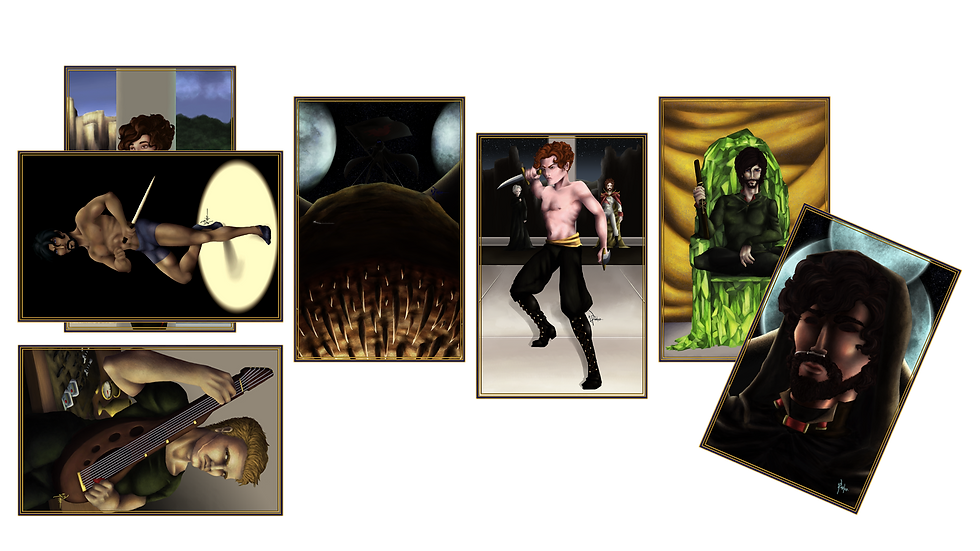
FOUNDATION: THE MAGICIAN
(Gurney Halleck)

Perspective is necessary when approaching life’s questions to establish context; so too with the tarot. All things require a Foundation, even Usul, the base of the pillar. The Magician implies this principle with his pose, raising one hand to the sky and the other towards the ground. Heaven and earth, gods and men, author and text. He indicates a connection between the literal and the metaphorical and reminds us that we, the readers, have our place as well.
As above, so below.
As for the man himself, Gurney Halleck may be better known as a troubadour-warrior, but that’s just semantics. He’s a man of both wisdom and action; knowing when and where each are required. With his wand - or rather, his baliset - he gestures upward, articulating the will of his spirit with his fingerings, drawing down the moon as he strums. He is well-versed in culture and tradition and he understands their intrinsic link to humanity’s deeper nature.
To Paul, Gurney is his favorite companion-teacher, the sort of adult that a teenager on the cusp of adulthood might consider a friend, more than just a mentor. His baliset may stir the soul but he can just as easily use it to play a racy verse about Galacian girls - when Jessica is out of earshot, that is. Paul has no peers to engage with, so Gurney tolerates the “young pup’s” pranks with good humor and returns the favor in kind, a rare note of levity in a novel full of people who take themselves extremely seriously.
Paul’s normal instructor would be Duncan Idaho, his father’s finest swordmaster, but Gurney is no mean substitute. Duncan himself would later admit that Gurney could best him in a duel “six times out of ten.” Whatever he lacks in finesse he more than makes up for in blunt ferocity, harnessing his passions as deftly as he does his baliset.
GURNEY HALLECK
Duncan’s gone to lead the second wave onto Arrakis. All you have left is poor old Gurney who’s fresh out of fight and spoiling for music.
And it was decided in council that you being such a poor fighter we’d best teach you the music trade so’s you won’t waste your life entire.
Laid out on his table are tools to be kept close at hand, important lessons for his young pupil: A chalice, that his inner thirsts are satisfied; a compass, that the ground he walks might ever bear a path; swords, that his wits remain focused, sharp, and balanced. Paul must be well-practiced with each of these tools to lead a fulfilling life and prosperous world, but the young dukeling hasn’t quite “found the mood” for life’s harsher realities, and this Gurney cannot abide.
GURNEY
Mood? What has mood to do with it? You fight when the necessity arises - no matter the mood! Mood’s a thing for cattle or making love or playing the baliset. It’s not for fighting.
In the Art of Ruling I drew a comparison between Gurney Halleck and the “prayers of the righteous” from Gaius Helen Mohaim’s lecture, and this is the reason I say so. Gurney has pledged his life and loyalty to Paul’s father, Duke Leto Atreides, who liberated him from the Harkonnen slavers that scarred his face with an inkvine whip and systematically murdered his family - a righteous cause indeed, but not in any religious capacity. Instead it refers to Dune’s themes of balance, integration, and personal completeness that we’ve been exploring all throughout this series. Remember, Frank Herbert was Zen Buddhist, so inner wholeness is of central importance. In fact, most of his direct references to religion are probably meant to be understood more allegorically than literally, though it can certainly be read both ways. He calls attention to religion as an institution that imposes form and order onto the world broadly as a societal entity, regardless of the veracity of its claims or the morality of its adherents.
As a foundation, Gurney is a starting point to analyze Paul’s development, a character who’s instrumental in his upbringing but largely absent from his life in the years before his ascent to the throne. He is perhaps the most well-rounded of the adults in Paul’s life, and one of his most active positive influences. He teaches Paul to be perceptive, thoughtful, aware of his place in his surroundings; to approach each moment with the attention it deserves. If we’re going to understand Paul’s development, and therefore develop ourselves, it’s important that we keep this perspective in mind.
Throughout Dune Paul is involved in countless battles but he’s only involved in three narrated combat scenes, if we count his spar with Gurney as the first. Considering that Gurney’s sudden ferocity causes Paul to fight back like his life depended on it, I’m willing to say it counts. Like the other combat sequences, this is a duel: an intensely personal test of wits and speed. With one duel for each of Dune’s three parts, they’re a perfect reference to measure Paul’s growth from one to the next.
So let's establish the style of combat Paul studies:
PAUL
In shield fighting, one moves fast on defense, slow on attack. Attack has the sole purpose of tricking the opponent into a misstep, setting him up for the attack sinister. The shield turns the fast blow, admits the slow kindjal!
Shield fighting relies on strict, tight control of your movements, drawing an opponent’s attention with a relentless assault to conceal a slower, more deliberate blade - the true threat. Plans within plans and feints within feints. Paul understands the theory of it well enough, but he’s still naive to the myriad of ways he can fall prey to deception from his opponent or himself, still unaware of his vulnerability to the underhanded tactics of those who care little for rules and propriety.
Now, the fact that shields stop being used entirely once House Atreides arrives on Arrakis would seem to render this whole focus on shield fighting completely moot, and it does! That’s actually the point. Paul may be intelligent and studious, but he’s woefully unprepared for the reality that exists just outside of his tight, protective bubble. Careful consideration and strategizing are luxuries rarely afforded to most, as Gurney well knows. Hence his fixation on Paul’s mood: proof that the young pup has taken this luxury for granted.
GURNEY
Speed, excellent. But you were wide open for an underhanded counter with a slip-tip.
As a plot device Paul’s spar with Gurney is exactly what you’d expect. Gurney utilizes their duel to identify the primary flaw in Paul’s method and exploit it as an object lesson. This sets Paul up for a character arc aligning with some kind of resolution to this flaw in the story that follows. His failure to correctly address it in this first duel allows subsequent duels to act as points of comparison after he’s been allowed time to mature, so keep that in mind as we continue.
But we’re getting a little ahead of ourselves. Let’s finally establish the Subject of this reading.
SUBJECT: THE FOOL
(Paul Atreides)

PRINCESS IRULAN
Many have remarked the speed with which Muad’Dib learned the necessities of Arrakis. The Bene Gesserit, of course, know the basis of this speed. For the others, we can say that Muad’Dib learned rapidly because his first training was in how to learn. And the first lesson of all was the basic trust that he could learn. It is shocking to find how many people do not believe they can learn, and how many more believe learning to be difficult. Muad’Dib knew that every experience carries its lesson.
As we come full circle back to Paul again, the tarot deck resets as well. The Fool is number Zero, the hero for whom the call to adventure has not yet come. An empty vessel with no experience, eager to partake of the universe around him and blissfully unaware of its cruelties. Don’t misunderstand, the Fool isn’t dumb, just naive. He hasn’t learned to watch his steps for pitfalls and snares; doesn't realize the extent of his own vulnerability - yet. He’s pulled along by the current of fate, not yet aware that he can paddle against it. If this sounds familiar, it should. The Fool is the archetype many protagonists refer to in a coming of age tale, and to that extent, Paul is Frank Herbert’s description of his own target audience. Paul is You, the surrogate that we’re meant to latch onto, experience the plot through, and grow alongside.
Paul is a very insular 15-year old. He has no peers as friends, the only company he keeps are his mentors, like Gurney Halleck. Paul is usually physically isolated and often the only character in his scenes. He’s attentive and smart, but generally passive. He’s very comfortable with being alone, maybe even at his most comfortable. If Paul isn’t being actively engaged about his education or training he’s nearly always sequestered by himself. In chapters narrated from Paul’s perspective, if other characters appear they will typically come to him. He rarely seeks out companionship and is content to keep to himself when left to his own devices. He honestly comes across like a nerd, constantly alone or busy with his studies. When others are present he regularly allows them to steer the conversation and drive the plot forward while passively observing from the periphery with his unique synthesis of Bene Gesserit and mentat attentiveness. After all, “a mentat requires data” and the Bene Gesserit are patient by nature.
IRULAN
At the age of fifteen, he had already learned silence.
It would be fair to accuse Dune of mostly being dialogues and soliloquies, but even in that context Paul is particularly passive and introverted. It makes sense for your protagonist to be relatable to your readers, but these aren’t really the typical traits you would expect to see in a young hero preparing to set out on a grand adventure. In fact, Paul almost seems reluctant to engage in any sort of action, and more than you might expect from a typical rejection of the call to adventure. Once House Atreides arrives in their new home in Arrakeen he remains shuttered in his room, preferring Dr. Yueh’s film-books to firsthand exploration. Even when he’s threatened by a deadly hunter-seeker drone he delays as long as possible, only springing into action when Mapes’s entry forces his hand. This reluctance to act is one of Paul’s most consistent traits, something he carries with him even into Dune Messiah and beyond, a strong indication that it goes well past basic sympathetic characterization. Later, once the plot has taken off, the narration even goes so far as to point it out directly:
NARRATOR
The vision made him want to freeze into immobility, but this, too, was action with its consequences.
To that end, Paul’s hesitancy might be a subtle nod to the fact that he’s not supposed to be the protagonist of this story - at least, not from the Bene Gesserit perspective. According to the Breeding Plan, Paul should have been the girl who would one day be the Kwisatz Haderach’s mother, not the Kwisatz Haderach himself. He was meant to become the woman who trains the Bene Gesserit Totality in his ultimate, terrible purpose. With that in mind, perhaps he’s learned this hesitancy in earnest, instinctively sensing somehow that he’s fallen out of step with the established order. In any case, the role carved out for Paul was never meant to be one of action but rather careful preparation, and this is reflected in his carefully reinforced tendency to observe and analyze. So much so that he regularly interrupts the flow of a scene for paragraphs or even pages at a time in the interest of carefully calculating his next response, a lack of initiative that actually causes him to miss important windows of opportunity:
NARRATOR
And Paul [...] felt that a vital moment had passed him, that he had missed an essential decision and was now caught up in his own myth.
Nevertheless, whether or not he was meant to be, Paul is the protagonist, much like how you are who you are, despite the circumstances in which you find yourself. Prescience, as we see, is not perfect, people can’t always be perfectly predicted. Free will inevitably introduces entropy into a system. There’s always room for error. In that regard, Paul’s very existence is Dune’s thesis statement that “life, uh uh, finds a way.”
And just like a genetically modified velociraptor - also born the wrong sex and outside its proper time - the circumstances of Paul's birth are only the beginning.
Sorry, what was I talking about? Oh right, free will and the consequences of playing god.
The Fool reminds us that it’s important to take time to understand the role you play in your own life, separate from the one set aside for you by others. This understanding of agency allows us to transcend beyond the barriers placed around us by the expectations of others and to question the motives of those who have the greatest influence over us. It’s what allows us to make our own choices in life. Ultimately, the key lesson every Fool must learn is that agency infers responsibility, not just for your own actions, but also in choosing whether to accept or reject the path prepared for you and all that entails. Only then can you properly rise from adolescence into full adulthood.
And how better to rise than to a challenge?
CHALLENGE: THE HANGED MAN
(Jamis)

JAMIS
I choose the combat.
JESSICA
What is this?
STILGAR
It is the amtal rule, Jamis is demanding the right to test your part in the legend.
A lot happens in the time between the arrival of House Atreides on Arrakis and its fall during the siege at Arrakeen. Dr. Yueh kidnaps Duke Leto and both die in a failed attempt to assassinate their mutual enemy, Baron Harkonnen. Duncan Idaho rescues Paul and Jessica in the desert after a harrowing escape and brings them to Liet Kynes, who sets Paul on the path to Stilgar. Duncan falls to the Sardaukar to cover their retreat and Kynes leads their pursuers away, ultimately meeting a grim fate of his own soon after.
Though challenged, Paul has yet to seize control of his life, swept up by the currents of fate like little more than “Chips in the path of a flood,” as Jessica once put it. Now, abruptly, Paul is thrust into the open desert: a vast alien landscape where every footstep must be taken with the greatest of caution. Until now his path was laid out before him: Dr. Yueh’s sabotaged ornithopter, Duncan’s sense of duty, Kynes’s faith. For now, Paul’s next steps are clear: to survive he must seek out the Fremen, and even that was originally his father’s idea. Once he finds them, however, Paul must quickly learn to make his own decisions and face the consequences.
Hence the Hanged Man, who represents trials and sacrifice, portrayed by Jamis, the Fremen Paul must fight to the death to earn his place. The Hanged Man is associated with divine revelation, mirroring Jamis’s preoccupation with the prophecies Paul is meant to be tested against. Furthermore, he represents a life in suspension, an apt description for a duel to the death.
Speaking of suspension, the keen-eyed among you may have noticed that this Hanged Man is, in fact, not hanging. Isn’t he supposed to be upside-down?
And you’re right, he is - or rather, he would be. This time, however, the Hanged Man has been drawn in the reversed position, and no, not just so I wouldn’t have to doodle this whole card upside-down. When a card is reversed, its meanings are inverted. That doesn’t mean that everything I said just now is actually the opposite, though, all of that still stands. Rather, it means that, just like the Hanged Man, your perspective is being manipulated so you only see things in a particular way, starting with the premise of this challenge in the first place.
JAMIS
She must be championed. If her champion wins, that’s the truth in it. But it’s said that she’d need no champion from the Fremen - which can mean only that she brings her own champion.
JESSICA
I’m always my own champion. The meaning’s simple enough for--
JAMIS
You’ll not tell us our ways! Not without more proof than I’ve seen.
Jamis uses the language of prophecy and tradition to challenge Jessica to a duel to the death, knowing this will force Paul to act as her champion. Risking his life to prove the messiah has come might seem in-character for an especially fervent would-be martyr, but it’s rooted in something much deeper than the Bene Gesserit propaganda has led him to believe. Jamis demands proof the prophecies are being fulfilled, but the explanations provided by Stilgar in the moment point back to simple pragmatism and a damaged ego.
STILGAR
Jamis is one to hold a grudge, Sayyadina. Your son bested him and--
JAMIS
It was an accident! There was witch-force at Tuono Basin and I’ll prove it now!
STILGAR
--and I’ve bested him myself. He seeks by this tahaddi challenge to get back at me as well. There’s too much violence in Jamis for him to ever make a good leader - too much ghafla, the distraction. He gives his mouth to the rules and his heart to the sarfa, the turning away. No, he could never make a good leader.
JAMIS
Stilgar-r-r-r!
Beyond Jamis’s personal feelings, taking on extra bodies and allowing them access to a sietch is fundamentally dangerous. The Fremen would have been expecting a lone Reverend Mother, hence why Jessica is so readily accepted as Sayyadina but there’s resistance to taking on Paul. Their prophecies only mention a woman, not her teenaged son. For the brutalist Fremen this is a serious problem, but not for any religious reason. After all, once Paul defeats Jamis he has no trouble being integrated into their belief system despite inconsistencies. No, Paul’s duel with Jamis is necessary purely on a practical level, not because Paul is an anomaly in some prophecy. Any weak link or extraneous weight weakens the chain as a whole. Taking on extra bodies that must be kept hydrated with precious shared water is a massive potential threat to the entire community, especially if that extra body lacks their strict water discipline. Now they must consider taking on more than they had anticipated, an act that demands a sacrifice in one way or another. Jamis is simply attempting to prevent the scope of that sacrifice from extending out to the whole community by limiting the risks to just Paul and himself.
As we discussed in the Science of Religion, the Fremen’s traditions have been exploited by the Panoplia Prophetica, the psy-ops branch of the Bene Gesserit responsible for planetary-scale pseudo-religious thought reform for the purpose of facilitating the goals of their Kwisatz Haderach eugenics program. Unbeknownst to the Fremen themselves, their culture has been systematically twisted over the course of many generations to best serve the ulterior motives of the Bene Gesserit. An act of cultural appropriation resembling the manipulation of long-standing pagan holidays and customs to gaslight a people into believing that they were always secretly Christian, actually. Rather than replacing traditions, it’s much easier to convince people to keep doing what they’re doing and just manipulate their perceptions of why, especially if you can do it covertly from within.
Thus we have Jamis, a devotee with tremendous zeal for a faith totally fabricated by the Bene Gesserit in order to facilitate these exact moments. A pawn to be taken by the Kwisatz Haderach in the early game to prove his competence. A means to convince the Fremen to hand themselves over willingly into his service. A sacrifice to consecrate the arrival of their Lisan al-Gaib, the Voice from the Outer World.
A man who died in impotent rage, thinking that Paul was drawing out his final moments just to humiliate him.
And there’s the more direct reason why the Hanged Man is drawn in reverse: in their fight, Jamis doesn’t even come close. The duel isn’t the challenge. Jamis isn’t even Paul’s actual opponent, Paul is. The real challenge is whether or not Paul can realize that he and Jamis are, in fact, the same. They’re both being manipulated into accepting mystical explanations to justify and - most importantly - obscure their all-too mundane motives, even from themselves. Especially from themselves.
In contrast to his spar with Gurney, Paul still hasn’t gained an awareness of cruelty, as opposed to necessity, and it causes him to act with cruelty as a result, despite his best intentions. Needless to say, Paul survives the ordeal but does he meet the challenge? Does he realize that he, like Jamis, is being manipulated into believing that he - or anyone, for that matter - has some inborn right to rule over a people he knows nothing about? As analytical as he is, does he deeply interrogate that premise or question its validity like we've known him to do in so many other cases?
Does he even try?
It may seem like I’m being harsh, but again, out in the open desert even just one misstep can summon a catastrophe.
PAUL
I was a friend of Jamis.
Jamis taught me … that … when you kill … you pay for it. I wish I’d known Jamis better.
WHAT COMES NEXT: DEATH
(Shai-Hulud)

IRULAN
There is in all things a pattern that is part of our universe. It has symmetry, elegance, and grace - those qualities you find always in that which the true artist captures. You can find it in the turning of the seasons, in the way sand trails along a ridge, in the branch clusters of the creosote bush or the pattern of its leaves. We try to copy these patterns in our lives and our society, seeking the rhythms, the dances, the forms that comfort. Yet, it is possible to see the peril in the finding of ultimate perfection. It is clear that the ultimate pattern contains its own fixity. In such perfection, all things move toward death.
It’s only natural that Death would follow the Hanged Man, a sacrifice for divine revelation. The Norse All-Father Odin hanged himself from a tree for such insights, understanding them to be worthy of enormous cost. Across cultures death comes in many forms. A skeletal rider upon a pale horse, a reaper with a scythe, a crone with her scissors, a man with the head of a jackal, a woman scorned.
On Arrakis, this could only be the all-consuming gods below: the sand worm. Shai-Hulud. “Old Father Eternity.”
Any novice tarot reader will tell you that the Death card isn’t necessarily a bad omen. It heralds the end of something, but typically nothing quite so literal as a life. There’s more than 200 pages left in just this first book, so Paul obviously isn’t going anywhere yet - sorry Gaius Helen. However, the significance of this metaphorical death is just as impactful. Rather than an explicit end, Death is a transition, the end of one state and the beginning of another. An overlapping cycle of cycles that all things are ultimately subject to. The sandtrout isolate the water from their environment to expand their deserts, killing off the plant life and spreading the barren sand, only to sacrifice themselves individually to combine into a greater and greater whole. Thus they eventually become a worm, the perfect apex predator. It utterly conquers its territory with total disregard for its previous inhabitants, spreading desolation far and wide. And why shouldn’t it? The worm is an omnivore and a cannibal with a voracious appetite, a population able to sustain itself - on itself - indefinitely. The worm is beholden to nothing but the will to survive, a runaway engine of life fueled by millions of little deaths. An ouroboros, functionally immortal from devouring its own tail.
These ancient, incomprehensible creatures are responsible for nearly all of the sand that covers the surface of Arrakis, once host to vast oceans in ages long forgotten. This is outright confirmed in later books, but even in Dune the suggestion is there when characters say “pan and graben” to describe the desert lowlands. The book’s glossary explains that a pan, in particular, “indicates a region once covered by open water,” mirroring the definition of a real-world salt pan, which is formed when all the standing water in a region evaporates away and leaves its salt content behind. The book’s glossary goes on to say that “Arrakis is believed to have at least one such area, although this remains open to argument.”
In a way, you could say that the worms have killed Arrakis itself, robbing it of its surface water and therefore its vegetation and wildlife, but even that wouldn’t be wholly accurate. Even without accounting for the Imperial settlements that huddle around its polar ice caps, Arrakis remains host to all manner of fauna and even some flora, to say nothing of the Fremen that thrive all throughout its deep deserts. Life has continued despite widespread desolation and embraces it as an essential part of its new form. A new cycle begins out of the end of the one previous. The Arrakis that once held seas has died, but Dune rises in its place, still teeming with potential.
How appropriate, then, that the sand worm is also responsible for spice, a drug that inflicts transcendent time upon its user. In the hands of the Bene Gesserit the raw, unrefined spice essence is known as the Water of Life, a lethal poison that suspends the unworthy in a neverending present unless she can convert it into pure spice melange within herself. This represents the Bene Gesserit acolyte breaking free of her limited single perspective as an individual person and connecting directly to her ancestors. What emerges is a Reverend Mother, a being whose life experiences have been unified with those of her female forebears. A matron with the wisdom of thousands of her elders in an expression of the Bene Gesserit’s ultimate philosophy: the shape of the vessel defines the shape of its contents.
As a quick aside, since we’re getting back into Jungian terminology again, it’s important to remember that gender in Dune is primarily meant to be understood as an expression of traits present in people of all sexes, but categorized by gender as a shorthand to emphasize dualism, similar to yin and yang, as an example. It’s definitely not my favorite way to categorize human behavior, but Carl Jung had a heavy impact on the author’s research and these themes are tightly interwoven all throughout the series as a whole. Just keep in mind that these meanings are metaphorical and not intended to reinforce stereotypes.
With that out of the way, feminine traits are generally associated with intuition, creativity, and the abstract or unknown. It refers to the instinct to nurture others, and a general sense of envelopment, without being too crude. Masculine traits, on the other hand, are usually associated with order and structure; emphasizing logic, calculation, and comprehension. A fully developed person, regardless of their physical sex, should have an equal amount of both feminine and masculine characteristics in balance with each other. This allows you to reflect humanity as a whole and makes you capable of understanding and empathizing with others regardless of their apparent differences.
This is actually why the Kwisatz Haderach has to be a man. Under normal circumstances, men who attempt to convert the Water of Life invariably fail and are killed in the process, but if one were to succeed it would allow him access to his male lineage, the other half of humanity that the Bene Gesserit are unable to perceive. When combined with Bene Gesserit training that would allow him to access his female ancestry as well, this would grant him unprecedented access to, effectively, all of humanity’s collective genealogical data.
Reading between the lines, the Bene Gesserit only bring about change through internalization because they have access to the ultimate store of feminine-coded wisdom, but they lack comparable insight to facilitate a proper externalization of this process. Law and order are masculine-coded, and in this way they lack the same level of insight to impose these principles in the precise and careful ways that they require. Hence why the Bene Gesserit are more of a shadow government that makes no effort to seize overt control, this is how they function most effectively. At least, that’s how it must be until the Kwisatz Haderach partakes of the spice agony for himself.
Thus we find ourselves inevitably drawn back again to the subject of Death. Paul has already learned to harness the worm in a literal, physical sense as its rider, but now he attempts to mount the ouroboros and subjugate time itself. This is the decision he’s been fighting against ever since he and Jessica spent their first night on the run in the desert, when his sharpened mentat awareness first learned to draw from the depths opened up by his Bene Gesserit training.
PAUL
It’s here. In me.
It goes on and on and on and on and--
JESSICA
Paul!
PAUL
Listen to me. You wanted a Reverend Mother to hear about my dreams. You listen in her place now. I’ve just had a waking dream. Do you know why?
JESSICA
You must calm yourself. If there’s--
PAUL
The spice. It’s in everything here - the air, the soil, the food, the geriatric spice. It’s like the Truthsayer drug. It’s a poison! A poison so subtle, so insidious … so irreversible. It won’t even kill you unless you stop taking it. We can’t leave Arrakis unless we take part of Arrakis with us.
You and the spice.
The spice changes anyone who gets this much of it, but thanks to you, I could bring the change to consciousness. I don’t get to leave it in the unconscious where its disturbance can be blanked out. I can see it.
JESSICA
Paul, you--
PAUL
I see it! We’re trapped here.
I must tell you about my waking dream.
Paul catches the first glimpse of his terrible purpose, something only hinted at before. More than a general sense of foreboding, this is something akin to direct knowledge of the future - or at least, that’s how Paul interprets it. The Jihad he and his Fremen will inflict upon the universe looms just over the horizon, and that’s only the beginning. Instinctively he seems to understand that the act of looking into the future solidifies its shape accordingly. The better he can perceive it, the truer it becomes; the more concrete the details, the more clear its pathways.
But spice, and more specifically prescience, is lethally addictive. You can never give it up, you can only cede more and more of yourself to the unnatural perspective beyond single-view time that it forces upon you, becoming less and less human as your life extends out longer and longer into an inescapable future of your own making.
IRULAN
Arrakis teaches the attitude of the knife -- chopping off what’s incomplete and saying: “Now it’s complete because it’s ended here.”
Death is inevitable, it lurks behind every decision we make and claims the parts of us we inevitably leave behind. Death can’t be avoided and is in fact our most constant companion all throughout our lives. In each moment death whittles us down into the shape we choose for ourselves according to our actions and inactions. We die in every moment only to be reborn in the next and slowly we are refined by this process, for better or worse.
By choosing to partake of the Water of Life, Paul excises all possible options for escape. He collapses the wave function of his future with such certainty that no other outcomes are possible, locking himself once and for all into his terrible purpose.
IRULAN
And it came to pass in the third year of the Desert War that Paul-Muad’Dib lay alone in the Cave of Birds beneath the kiswa hangings of an inner cell. And he lay as one dead, caught up in the revelation of the Water of Life, his being translated beyond the boundaries of time by the poison that gives life. Thus was the prophecy made true that the Lisan al-Gaib might be both dead and alive.
FINAL OBSTACLE: THE DEVIL
Feyd-Rautha Harkonnen

PAUL
Now Harkonnen shall kill Harkonnen.
The last time we discussed Feyd-Rautha it was mostly in service of understanding his uncle, Baron Harkonnen. The Baron thinks of his nephew - and indeed, all people - as tools to be wielded in the course of amassing greater wealth and power. Beyond being an extension of his uncle’s will, Feyd-Rautha also acts as something of a glimpse at Paul, if only his situation were a little different. As the Devil he is Paul’s nemesis, his foil, his every temptation compounded into a single being.
From Gaius Helen Mohaim’s perspective, a duel between Paul and Feyd-Rautha is nothing short of apocalyptic. Had Paul been born female as intended, she could have been mated with Feyd-Rautha, the final union required to produce the Kwisatz Haderach. Instead, the last two pieces of their elaborate puzzle are fundamentally incompatible. Worse, they’re too similar to be anything but rivals, and both have every reason to want the other dead. At least half of the breeding plan’s generations of work is guaranteed to be lost one way or another, with a significant chance that both will die and erase their progress entirely.
Despite the atmosphere of a long-fated duel, this is actually the first time Paul and Feyd-Rautha have shared even a star system in common with each other. If Feyd-Rautha hadn’t seized the opportunity to challenge Paul to single combat by right of kanly, their duel wouldn’t be necessary at all. Emperor Shaddam goes along with it primarily as a means to remove Paul’s threat to his authority, and even orders Count Fenring to finish Paul off when he fails to die at Feyd-Rautha’s hand. As with Baron Harkonnen, Feyd-Rautha is only a means to an end for the Emperor, in much the same way that Paul has been a pawn of the Bene Gesserit. Just like with Jamis before him, Feyd-Rautha is a reflection of Paul and their duel is an externalization of Paul’s inner conflict. The two live parallel lives and therefore observations made about one necessarily invite comparisons to the other.
As an example, both Feyd and Paul are introduced in scenes that would otherwise interlock, but mirror each other instead. In Chapter One, Paul learns from his mother and, effectively, her mother, that he was born for a special purpose, a meeting that should have been between three Bene Gesserit women to discuss the culmination of their Breeding Program and coordinate their final maneuvers. In Chapter Two, Feyd learns from his uncle and their mentat about the plot to topple House Atreides and position him as the rightful ruler of Arrakis, consolidating power to House Harkonnen that can eventually be leveraged to seize even greater power later. In their original conception both of these plots would have been viable, a consolidation of power from pairing Feyd-Rautha with his Atreides intended. A collection of Atreides loyalty and Harkonnen ambition blended together into a perfect balance, resulting in a man who commands both love and respect from his people while remaining dedicated to the necessity of certain cruelties.
Feyd-Rautha’s status as Paul’s foil is only bolstered from this point, each of his scenes having a direct contrast to one of Paul’s:
After he kills Jamis, Jessica immediately confronts Paul in an effort to dissuade him from growing to enjoy it.
JESSICA
Well-l-l now-- how does it feel to be a killer?
This fills Paul with deep shame and remorse over the life he has taken, emphasizing its inherent value. In the aftermath, Paul is called upon to eulogize Jamis, further solidifying to him that individual lives are precious.
Feyd-Rautha, on the other hand, is shown sadistically drawing out the slow and painful death of his hundredth opponent in gladiatorial combat to celebrate his seventeenth birthday. Feyd-Rautha’s hubris and lack of focus nearly gets him killed and he only survives to stand victorious by cheating. Crowing with unearned triumph he strikes down his foe.
FEYD-RAUTHA
Scum!
Countless onlookers shower Feyd-Rautha with adulation and Baron Harkonnen is forced to order a days-long fete to commemorate the occasion, further reinforcing this behavior in his nephew.
Paul struggles with the expectation of the Fremen that he should challenge Stilgar to take his place as leader, knowing that to do so he must kill a dear friend. Despite all the pressure on him to follow through with this long-standing tradition, he refuses to slay one of his greatest allies and convinces the Fremen to accept him as their leader regardless.
PAUL
Will I subtract from our strength when we need it most?
Though risky, Paul remains principled and manages to inspire even greater loyalty than before.
Meanwhile on Giedi Prime, Feyd-Rautha secretly plots his uncle’s assassination to hasten his own inevitable rise to power. He has no loyalty of any kind for the Baron and the details of his scheme seems to indicate a possible attempt at ironic revenge, given Feyd’s detailed insight into how the Baron likes to handle his victims. When the attempt fails, Feyd must be convinced of the Baron’s greater value to him as a highly experienced advisor, when the time comes. He reluctantly agrees that the Baron is more valuable to him alive … for now.
BARON HARKONNEN
Now you see how you need me. I'm yet of use, Feyd.
FEYD-RAUTHA
Yes, uncle.
Over and over again Feyd-Rautha is shown to be Paul’s dark mirror, as much opposed to him as he is the same. The fact that Paul defeats Feyd-Rautha is positioned as Paul’s victory over cruelty and oppression because the story is being told from Paul’s perspective, but again we have to ask ourselves if surviving the ordeal is the same as meeting the challenge.
Has Paul learned to recognize the cruelty of the world sufficiently enough that he can recognize it in himself? By carefully observing his opponent Paul realizes Feyd-Rautha is attempting to trick him with a hidden blade and anticipates that the dagger borrowed from Shaddam IV is coated with a soporific to dull his nerves. Though he doesn’t end the fight unscathed, he ultimately defeats his rival, revealing the Emperor’s treachery for all to see. Certainly he has learned to recognize cruelty, he’s no longer a naive dukeling who lacks the mood, but has he taken that final crucial step, like Duke Leto in his own showdown with a Harkonnen rival?
Does Paul recognize that he and Feyd-Rautha are one in the same, like two parts of a greater whole? Like his father before him, does Paul choose to accept the darkness within himself and attempt to understand it, even at the very, very last possible opportunity? Or does he flinch, fall to temptation, and allow himself to repeat the same, sad mistakes.
I wonder if Chani would call this a victory as she mourns the death of their infant son and watches her beloved marry into power.
JESSICA
And for the royal concubine?
CHANI KYNES
No title for me. Nothing. I beg of you.
OUTCOME: THE EMPEROR
Muad’Dib

Spoiler Warning!
If you haven’t read Dune Messiah yet and want to experience it for yourself before some nerd on the internet infodumps at you about it, then you should come back for these last parts once you have. Later I’ll try to kick out everyone that hasn’t read Children of Dune as well, so maybe just add that to the list too. Of course, that’s just my advice, you can do whatever you want. I’m not the Kwisatz Haderach, the Emperor, or The Preacher, but I do play him on YouTube, so that’s … something? I don’t know where I’m going with this anymore. You do you.
QIZARA
Such a rich store of myths enfolds Paul Muad’Dib, the Mentat Emperor, and his sister, Alia, it is difficult to see the real persons behind these veils. But there were, after all, a man born Paul Atreides and a woman born Alia. Their flesh was subject to space and time. And even though their oracular powers placed them beyond the usual limits of time and space, they came from human stock. They experienced real events which left real traces upon a real universe. To understand them, it must be seen that their catastrophe was the catastrophe of all mankind. This work is dedicated, then, not to Muad’Dib or his sister, but to their heirs - to all of us.
Twelve years have passed since Paul defeated Feyd-Rautha. Shaddam IV has been stripped of all his titles and CHOAM holdings to live out his remaining years in exile on the Corrino homeworld, Salusa Secundus. Ironically, this nearly inhospitable planet has been made exceedingly comfortable for the former emperor, transformed from a hellscape into a paradise to soften up his once-fearsome Sardaukar. Shaddam is Paul’s father-in-law after all, so having him killed probably would have made things a bit awkward back home.
Speaking of the princess-consort, we come to Irulan as she contemplates joining the conspiracy to assassinate her husband, and not for the reasons you might expect. Irulan’s entire life had been in preparation for bearing an imperial dynasty. To the extent that she is Bene Gesserit her training has all been in service of either statecraft or royal maternity, and Paul staunchly denies her the latter. In retaliation, Irulan has been surreptitiously adding contraceptives to Chani’s food, successfully preventing her from bearing any children as well. However, Irulan grows increasingly desperate as the years pass and Paul continues to refuse her. Eventually Chani embraces a fertility diet that can’t be tampered with, and this combination of things causes her to become very fertile as a result.
As Irulan’s very own self-fulfilling prophecy begins to close in around her, she finds herself consorting with a diverse cast of powerful players representing many of the shapes humanity has come to assume across the universe. Edric the Guild Navigator, whose extreme spice intake provides the rudimentary prescience required to maintain secrecy. Scytale the Face Dancer, an agent of the Tleilaxu, whose ulterior motives are hidden but certain. And of course, Gaius Helen Mohaim, Reverend Mother of the Bene Gesserit. Now joined by the Princess Consort, they are poised to administer a “psychic” poison: Hayt, a ghola whom the Tleilaxu have engineered from the late Duncan Idaho. A perfect likeness, save for his metallic eyes. He’s designed to perplex Paul, who can’t help but take Hayt into his service, and to entice Alia, who is young and manipulable. An assassin who warns his target immediately but is implicitly trusted regardless. Too familiar to be sent away, too intriguing to be destroyed.
But what of the Emperor himself?
Paul has accepted the mantle of godhood to the Fremen, allowing the Qizarate priesthood who enforce divine order to seize substantial power and influence. Some of the Imperium’s many worlds and Great Houses may have accepted this change of regime willingly, but if so, they were by no means unified in this regard. Soon there would be unrest, then conflict, and finally … Jihad. A crusade across the known universe to spread the religion of Muad’Dib at the point of a crysknife. A pogrom that continues to rage with no sign of stopping.
PAUL
There’s another Emperor I want you to note in passing - a Hitler. He killed more than six million. Pretty good for those days.
STILGAR
Killed … by his legions?
PAUL
Yes.
STILGAR
Not very impressive statistics, m’Lord.
PAUL
Very good, Stil. Statistics: at a conservative estimate, I’ve killed sixty-one billion, sterilized ninety planets, completely demoralized five hundred others. I’ve wiped out the followers of forty religions which had existed since--
QIZARA
Unbelievers! Unbelievers all!
PAUL
No. Believers.
QIZARA
My Liege makes a joke. The Jihad has brought ten thousand worlds into the shining light of--
PAUL
Into the darkness. We’ll be a hundred generations recovering from Muad’Dib’s Jihad. I find it hard to believe that anyone will ever surpass this.
STILGAR
What amuses Muad’Dib?
PAUL
I am not amused. I merely had a sudden vision of the Emperor Hitler saying something similar. No doubt he did.
It’s just not a Dune discussion until someone points out that Paul Atreides is the protagonist, but not the hero.
That said, Dune Messiah isn’t a rug pull about how Paul was actually a bad person all along. He’s still you. That’s not to say that all of you who hear this aren’t bad people - for all I know you’re playing this in the background while you murder a guy with an ax --
-- but that’s not what I mean, though it does have to do with getting lost in your own bullshit.
The point is that anyone’s perception of reality and themselves can be warped by their own preconceptions, and if left unchallenged this can cause you to lose sight of objective reality altogether.
In the tarot, the Emperor is a man of decisive action tempered by wisdom. He is not only the authority that sustains his position but also the structure that protects his people. A father-figure who deeply cares for those under his rule. In this way, the Outcome represents an ongoing challenge, and the most difficult one so far. Previously, the challenge was whether he could identify with an opponent and understand that “there go I, but for an accident of fate.” This time his opponent wears the face of a friend but carries none of his memories. A familiar stranger, trained as a Mentat and a Zensunni philosopher. As a Mentat, accurate data is key, and his Zensunni dedication to inner calm precedes deception, making him completely trustworthy despite the fact that he’s an obvious trap.
In many ways their goal is the same, but their perspectives are reversed. Paul is the Kwisatz Haderach, a Mentat with all of history at his disposal and a prophet of the future. Hayt - a ghola with no memories of Duncan’s - is a Mentat as well and also a Zensunni who strives for mindful awareness from within the present. Paul clings to the way things are, but the knowledge of the inevitable future prevents him from appreciating and living his life in the present. Hayt is a mind that’s always present, housed within a body that’s saturated with history for everyone but himself. Paul looks only within himself to seek the counsel of others, and when Hayt observes the outward actions of others he inevitably fixates on what traces of himself they reveal. This is the psychic poison. They are perfectly positioned to play off one another in an endless spiral of rhetoric:
HAYT
You’ve not brought your mind to rest at the beginning.
PAUL
Is that how you destroy me? Prevent me from collecting my thoughts?
HAYT
Can you collect chaos? We Zensunni say: “Not collecting, that is the ultimate gathering.” What can you gather without gathering yourself?
PAUL
I’m deviled by a vision and you spew nonsense! What do you know of prescience?
HAYT
I’ve seen the oracle at work. I’ve seen those who seek signs and omens for their individual destiny. They fear what they seek.
PAUL
My falling moon is real. It moves. It moves.
HAYT
Men always fear things which move by themselves. You fear your own powers, Things fall into your head from nowhere. When they fall out, where do they go?
PAUL
You comfort me with thorns.
HAYT
I give you what comfort I can.
As we discussed with Paul’s late father, the process of becoming whole and balanced involves an acceptance of the things you reject about yourself, recognizing that they are fundamental to your being and worthy of due respect. Leto rejected his vulnerabilities and neglected to tend to them properly, leaving himself defenseless to exploitation by his enemies. In his final moments he does embrace this part of himself and achieve this completeness, if only for a brief instant, but this obscures a greater truth: the process of accepting yourself and becoming a well-balanced individual is never finished. Every moment presents new opportunities, new decisions, new challenges. The underdog may yet rise, and the mighty can still fall.
Prescience creates a literal self-fulfilling prophecy that solidifies the shape of the present and projects it into the future. Paul understands the atrocities that he facilitates, the cycles of his abuse amplified to the scale of all the known universe, and realizes that even his death couldn’t bring his Jihad to an end because the zealotry would continue unabated in his name. He must find a way to disengage, but his paths have all been charted and each one leads inevitably to ruin. He becomes even more passive, falling back into over-analysis, and this, too, [is] action with its consequences. Paul only begins to make meaningful progress when he decides to defy his visions and take action to shape his future according to his will, rather than anticipation of what must be.
IRULAN
When law and duty are one, united by religion, you never become fully conscious, fully aware of yourself. You are always a little less than an individual.
Near the conclusion of Dune Messiah, Paul begins to push the limits of his vision. He ignores the sign of danger and allows himself to be caught in the radius of a stone burner, a weapon that uses nuclear fuel to drill deep under the surface of a planet. If it doesn’t breach into the planet’s molten core and crack it apart completely, the site of its impact is bathed in a kind of radiation that breaks down the soft tissues in the eyes of its victims, causing them to melt from their sockets mere minutes after exposure. Paul orders prosthetics for all the victims at his expense but refuses to accept them for himself. He must enter into the final stages of his challenge to defy his prescience as it threatens to dominate his perspective completely, relying instead on hope and his own will to reshape the future. To rise to this challenge he must become truly blind and venture forth into a dark universe he can no longer predict.
Inevitably that moment comes, when Chani loses her life delivering their twins. The dreaded future has come to pass, triggering Hayt’s secret mental compulsion to murder Paul when he’s at his most vulnerable. Instead, Hayt struggles against this compulsion. He can’t bring himself to betray Duncan Idaho because fundamentally Hayt is Duncan Idaho, and with that acceptance the two are made whole: Hayt’s identity is maintained and Duncan’s memories are restored.
Thus the real Tleilaxu trap is sprung. Scytale, the Face Dancer, emerges once more with a proposition: if Duncan’s memories can be restored, why not Chani’s as well? Paul would only need to say the word and he would never be without his beloved Sihaya ever again, all it would cost him is everything. Threatening the lives of his infant twins, Scytale implores him to act wisely, but swiftly.
Paul is utterly blind and overwhelmed by grief. His prescience has never hinted at these events before, and soon it becomes clear why: Paul’s twins are preborn. They represent a different future altogether, one that Paul could not have seen clearly because it belongs to those who must live it. Paul must learn to let go, just like his father before him. Only then does he realize that he can see himself - from the perspective of his infant son. This anchors Paul in the present once more and fills him with resolve to protect the future by entrusting it to those who follow, even though it means he will never get Chani back. Just like Hayt, he surrenders himself to that which he fears most and in the process he achieves his enlightenment.
You may be wondering why this card isn’t reversed. It certainly seems like Paul has failed to live up to the standards the Emperor card lays out for him, but I don’t think this is actually the case. Out of this revelation Paul’s blindness returns permanently, and the Fremen have strict laws regarding the blind. They are brutalist by nature, borne out of the necessity imposed by their harsh environment, and the safety of the community is paramount. They believe that the blind cannot be abided, for the good of the whole, and thus they are granted ownership of the water of their flesh, to wander the desert alone until Shai-Hulud takes them. A sacrifice for the better of the community, to ensure its survival. Paul realizes that the best way to embody the principles of the Emperor is, ironically, to step down as emperor. To discredit himself as Kwisatz Haderach and accept that he is merely Paul. To go out into the desert utterly blind to live or die by the demands of the present, with no certainty as to what the future may bring.
After all, power attracts the corruptible, and sometimes the most responsible thing one can do with the power they’ve attained is set it aside.
Spoiler Warning!
If you haven’t read Children of Dune, this is that part I was talking about before where I’m kicking you out, unless you don’t care about spoilers. Or maybe you just can’t be bothered to skip to the next video so this is just your life now. I can respect that.
STILGAR
Come, Alia is back and asking for you.
DUNCAN IDAHO
She was with you at Sietch Makab?
STILGAR
Yes - she helped whip those soft Naibs into line. They take her orders now … as I do.
DUNCAN
What orders?
STILGAR
She commanded the execution of the traitors.
DUNCAN
Oh. Which traitors?
STILGAR
The Guildsman, the Reverend Mother, Korba … a few others.
DUNCAN
You slew a Reverend Mother?
STILGAR
I did. Muad’Dib left word that it should not be done. But I disobeyed him, as Alia knew I would.
CONCLUSION: THE HERMIT
The Preacher

If you’re familiar with the tarot you might expect a reading to end once the card in the Outcome position is revealed. If it was prompted by a question, the Outcome would be where you’d expect to find your answer. When I designed this spread, I decided to include a position for a Conclusion as well, in acknowledgement of life’s cyclical nature. Much like how the Death card was drawn in the position of what comes Next, the Conclusion follows the Outcome to emphasize a fundamental truth: that this too will pass. Tomorrow will always come, with or without you.
In the eight years since Paul walked into the desert this principle plays out on a grand scale across the Imperium. Under the regency of Alia - possessed by Baron Harkonnen - Muad’Dib’s Jihad continues to radicalize all who aren’t culled in its resistance. An endless stream of pilgrims grows with each passing year as more and more pledge themselves to the royal divinity. Amongst their multitudes a very different sort of visitor arrives to set out on a pilgrimage of her own.
JESSICA
Jessica scanned the landscape once more. Many differences submitted to her searching stare. A prayer balcony had been added to the landing field’s control tower. And visible far off to the left across the plain stood the awesome pile of plasteel which Paul had built as his fortress - his “sietch above the sand.” It was the largest integrated single construction ever to rise from the hand of man. Entire cities could have been housed within its walls and room to spare. Now it housed the most powerful governing force in the Imperium. Alia’s “Society of the Faithful,” which she had built upon her brother’s body.
That place must go, she thought.
Meanwhile, within the city, the Temple of Alia plays host to another, altogether different stranger. A grizzled, aging Fremen with burned out eyes, escorted by an irreverent young guide. They walk past the many vendors peddling so-called holy relics, merchants with hawks “trained to screech a ‘call to heaven,’” and a couple of buskers performing for a crowd. Suddenly a group of several dozen Sand Dancers appear, bound together by elacca rope and delirium from days of dancing in spiritual ecstacy. “A full third” of these dancers have collapsed from exhaustion, swaying limply as they’re dragged along by their fellows. One of these collapsed dancers begins to rouse, disturbed by visions:
AWAKENED DANCER
I have see-ee-een! I have see-ee-een!
Frantically he cries out that he has seen the future, one where the desert has completely reclaimed the very temple they stand in now, and the entire capital complex that houses it, and nothing remains to mark its passing, only sand. He struggles against the other dancers, looking all around him as he cries out to anyone who will listen.
AWAKENED DANCER
I have see-ee-een!
The crowd, looking on in anticipation, begins to laugh at the exhausted dancer, who continues to rave and shout. This is more than the blind man can bear.
PREACHER
Silence!
Did you not hear that man? Blasphemers and idolaters! All of you! The religion of Muad’Dib is not Muad’Dib. He spurns it as he spurns you! Sand will cover this place. Sand will cover you.
Take me from this place.
At first glance it bears more than a passing resemblance to the Biblical “cleansing of the temple,” referenced in the New Testament gospels. Jesus had visited the temple in Jerusalem and was appalled to see it filled with merchants and vendors in flagrant disrespect of the sanctity that space was meant to contain. Much like the Preacher, Jesus shouts his outrage, overturning tables to cast the merchandise onto the floor and storming out once he’s finished his rebuke. It’s commonly held that this is most likely the inciting incident that eventually led to Jesus’s trial and crucifixion, similar to how the Preacher’s own demise is foreshadowed in his version. If this scene in Children of Dune ended right here, there wouldn’t be anything else to say - the last book was called Dune Messiah, for god’s sake, the author was making no attempt to obscure his influences. It allows him to engage with those influences directly without having to be so concerned about getting lost in the metaphor. The scene does continue, however, as someone from within the crowd shouts after the Preacher to ask whether he is Muad’Dib returned:
NARRATOR
The Preacher stopped, reached into the purse beneath his bourka, and removed an object which only those nearby recognized. It was a desert-mummified human hand, one of the planet’s jokes on mortality which occasionally turned up in sand and were universally regarded as communications from Shai-Hulud. The hand had been desiccated into a tight fist which ended in white bone scarred by sandblast winds.
PREACHER
“I bring the Hand of God, and that is all I bring! I speak for the Hand of God. I am the Preacher.”
With this additional context a very different conclusion can be drawn as for whom the Preacher might be an allegory: Friedrich Nietzsche's recurring protagonist, Zarathustra. Specifically this scene and others in Children of Dune bear a resemblance to events that take place in Thus Spake Zarathustra, particularly in reference to the title character’s claim that “God is dead,” echoed by the Preacher’s mummified Hand of God. Illustrating the truth of Muad’Dib’s mortality will prove to be the Preacher’s driving motivation from this point forward, but as far as Nietzsche is concerned, we’re just getting started.
That said, it’s worth taking some time to break down some of the concepts being engaged with. After all, misunderstanding Nietzsche is how you get Nazis, and that’s pretty much the exact opposite of what I’m trying to do here, in case that wasn’t clear.
When Zarathustra claims that God is dead, Nietzsche is trying to convey that humanity has reached a point where religion and other institutions have caused people to reject important aspects of life in favor of what they believe to come next, whether it be Heaven, the next life, the void, or whatever else. If God is dead, however, then the responsibility falls back on humanity to live life fully while we’re afforded the opportunity, lest we stagnate as individuals, and therefore as a society. He stresses that all people walk a tightrope stretched between their base animalistic nature and their higher potential - what he refers to as the Ubermensch - an ideal to which one should strive. Ultimately this fuels the cycle of eternal recurrence by which history is set and the future is shaped, a tension between the extremes of stagnation and chaos; emphasizing living in accordance to your will, rather than only according to your needs.
The awakened sand dancer is a microcosm of this concept, literally bound by rope to the others around him. Rising from unconsciousness he comes to the realization that all things are impermanent, that even the massive structures all around them are destined to be nothing but sand in the face of time’s endless procession. He struggles against the other dancers, exerting his will as he fights to warn the people around him not to take their present circumstances for granted, to wake up to that same fundamental truth from before: that tomorrow will always come, with or without you. When the crowd laughs at him, they are effectively rejecting progress and accepting stagnation, and this is what the Preacher can’t abide. Thus Frank Herbert has united Jesus’s cleansing of the temple with Nietzsche’s will to power: the temple of humanity’s higher aspirations has become stagnant and decadent, and the only solution is to be rid of that which doesn’t affirm life. To remove corruption and seize responsibility for one’s own growth by taking an active hand in it, and inspiring others to do the same by your example.
Don’t get me wrong, Dune has been riffing on Christianity heavily the entire time, but typically in a more overt way via the Bene Gesserit, so named to invoke the real-world Jesuit sect, and other even more direct references like the Orange Catholic Bible or the title Reverend Mother. This is almost certainly for the primary purpose of illustrating institutional stagnation within the Imperium that encourages life-denying attitudes, but as the series continues I believe it also takes on an increasingly important additional purpose. With each subsequent novel the reader is prompted ever more directly to question the base premises as they’re being presented, priming you to arrive naturally at the more gnostic conclusions being built towards and culminating in God-Emperor of Dune. That’s all waaaaay outside the scope of this video, but we are getting there, so keep it in the back of your mind for now.
As a side note, Nietzsche’s influence definitely runs throughout the entire series, Children of Dune is just what I’m choosing to focus on to highlight that for the purposes of this video. If you’re interested in more analysis of Nietzsche's influence on the Dune series overall, I highly recommend the essay Friedrich Nietzsche Goes to Space (link in description). Aside from covering Nietzsche's influence in greater detail, they also include quotes from his book as well. I will not be doing that because this video is already long enough, and anyway, mein Deutsch ist scheisse.
The Hermit, whether in the context of Jesus, Zarathustra, or the Preacher, indicates a need for isolation and introspection. Wisdom lives in the quiet, as the saying goes, and one can’t contemplate these things properly if your attention is constantly being drawn from one thing to the next. From the wilderness the Preacher is able to fully appreciate the shape of the Imperium he has created and understand that he has molded it inevitably after his own image. His terrible purpose has solidified around him as he realizes that it’s not enough to simply transform the universe by transforming yourself, nor is it enough to project your will onto reality to impose order and stability. These are the extremities that must be brought into balance, joined together by a tightrope upon which we endlessly travail over the course of our lives. Challenges arise and provide us opportunities to evolve, punctuated by periods of quiet that we sometimes must carve out for ourselves to allow the chance to collect our accumulated wisdom and integrate it into ourselves.
Moreover, the Preacher must come to affirm the conclusions he has already reached but has not yet fully accepted. The universe must move on and the next generation must be allowed to take responsibility for itself. This too shall pass, and so too must he.
PREACHER
Paul Atreides is no more. He tried to stand as a supreme moral symbol while he renounced all moral pretensions. He became a saint without a god, every word a blasphemy.
As the priests of Muad’Dib’s own religion drive their knives into the Preacher for his blasphemies - literally killing their god in his own name - it would be easy to allow yourself to become cynical. Indeed many would level this accusation at Nietzsche himself. However, I don’t believe that’s the conclusion Frank Herbert would have wanted you to reach. All throughout Paul’s life he was shaped by forces beyond his ability to control, whether it be Bene Gesserit grooming or the eradication of his House at the hands of his own grandfather. As unavoidable as these events may have been, there was always a decision to be made regarding how - or indeed, if - Paul chose to accept them, always an opportunity to meet the challenge of abuse and bring its cycle to a close. To greet life openly and engage with it fully, because this too shall pass and tomorrow will always come, but you have only this finite stretch of eternity upon which to make your mark on everything that follows.
PAUL
Ahhh, dearest one, we are so money-rich and so life-poor. I am evil, obstinate, stupid…
CHANI
You are not!
PAUL
That, too, is true. But my hands are blue with time. I think … I think I tried to invent life, not realizing it had already been invented.


Comments